Single Jersey vs Interlock vs Rib: A Knit Guide
The three knit structures behind most tees, activewear and loungewear — how they differ and when to use each.
Knits stretch and drape in ways wovens can't — which is why they dominate tees, activewear, loungewear and childrenswear. Three structures cover most garments you'll ever brief, and knowing how each behaves makes your specs sharper and your quotes faster.
Single jersey
The classic tee knit — smooth on the face, looped on the back. Light, breathable and stretchy in the width. The go-to for t-shirts and summer tops.
It's also the simplest and most economical knit to produce, which is why it carries most volume programmes. Typical weights run 120–160 GSM for lightweight tees, 160–200 GSM for standard retail, and 220 GSM and up for heavyweight streetwear.
Two behaviours to plan for. Cut edges curl — a cutting-room nuisance, manageable with proper fabric relaxation before spreading. And spirality (side seams twisting after wash) appears when yarn twist and machine settings aren't balanced; ask for spirality on your test reports and hold it under about 5%. Combed or compact yarn lifts the surface noticeably over carded.
Interlock
A double-knit that's smooth on both sides, more stable and fuller than single jersey. Holds shape well — good for polos, dresses and structured tops.
Knitted on two needle beds, interlock doesn't curl at the edges, gives better opacity at the same yarn count and resists laddering. Expect 180–260 GSM for most apparel uses. It costs more per kilogram than jersey — more yarn per square metre, slower knitting — but the stability shows in the garment, which is why babywear and premium basics lean on it.
Rib
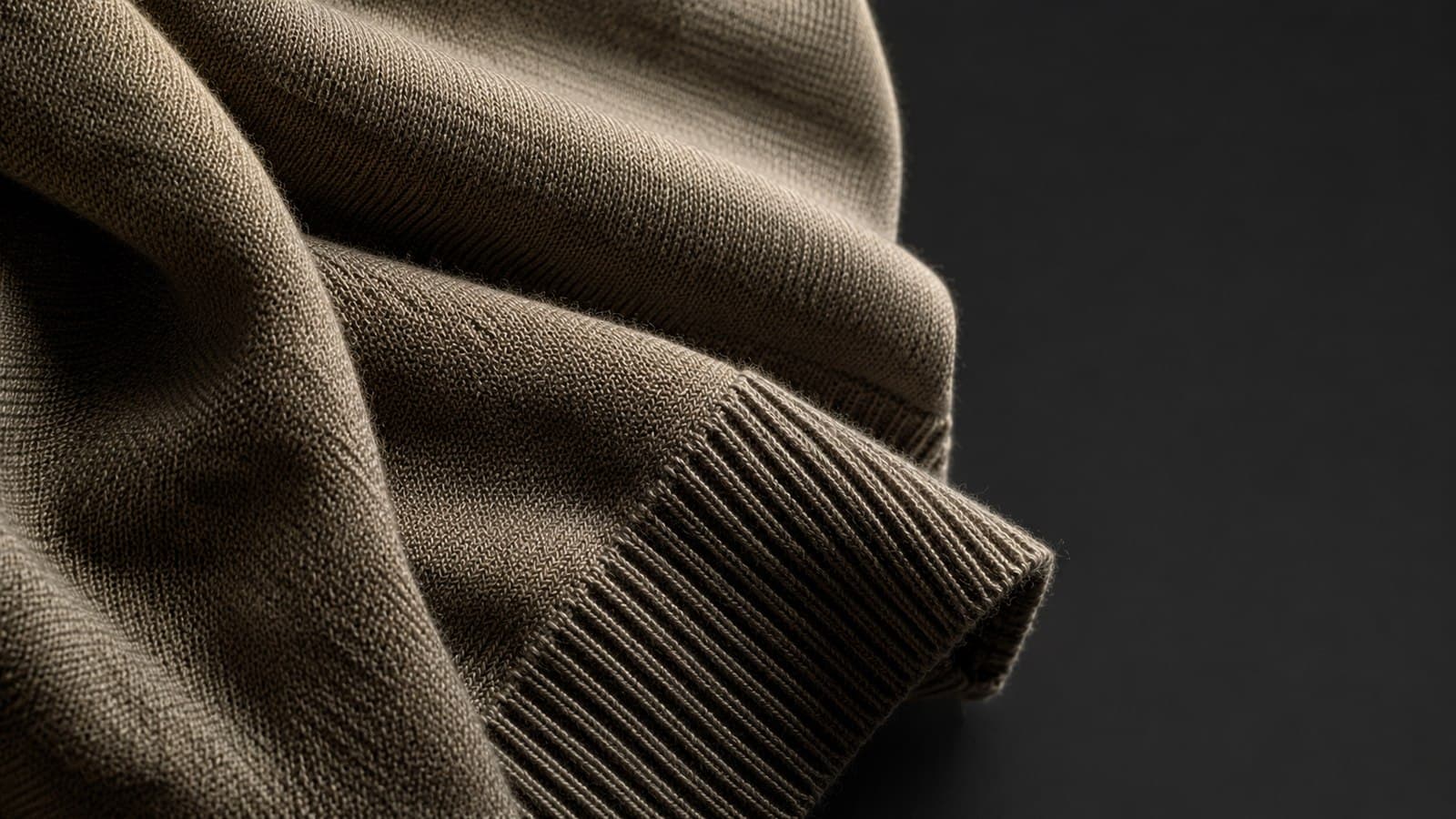
Vertical ribs (1×1, 2×2) that give strong widthwise stretch and recovery. Used for cuffs, collars, waistbands and fitted, stretchy garments.
Rib's alternating knit-and-purl wales let it stretch well beyond its relaxed width and snap back — the reason trims are almost always rib. As a body fabric (usually 180–300 GSM) it gives close-fitting silhouettes even without elastane, though 3–5% elastane sharpens recovery for necklines that must survive daily wear.
Side by side
| Single jersey | Interlock | 1×1 rib | |
|---|---|---|---|
| Face / back | Smooth / looped | Smooth both sides | Ribbed both sides |
| Widthwise stretch | Moderate | Low–moderate | High |
| Recovery | Fair | Good | Excellent |
| Edge curl | Yes | No | No |
| Typical GSM | 120–220 | 180–260 | 180–300 |
| Relative cost | Lowest | Highest | Middle |
Choosing a knit
- Stretch & recovery — rib recovers best; interlock is most stable.
- Weight (GSM) — lightweight jersey for tees, heavier for structure.
- Blend — cotton for comfort; add elastane for stretch; poly blends for performance.
- Surface expectations — if the garment will be enzyme-washed or brushed, say so; finishing changes both hand-feel and final GSM.
What to tell your sourcing partner
- End use and target GSM after finishing
- Fibre blend, and elastane percentage if any
- Yarn quality — carded, combed or compact
- Finish: enzyme-washed, brushed, bio-polished
- Shrinkage and spirality tolerances, plus your wash-test method
- Colour route: piece-dyed, yarn-dyed or printed
That single paragraph of detail is usually the difference between one accurate counter-sample and three rounds of guesswork.
Our knit qualities are developed to order to your GSM, blend and finish.
Ready to source this?
Free swatches, honest lead times, one accountable partner.
Request free swatches